-
![]()
Daisy
Daisy is the Senior editor of the writing team for EaseUS. She has been working in EaseUS for over ten years, starting from a technical writer to a team leader of the content group. As a professional author for over 10 years, she writes a lot to help people overcome their tech troubles.…Read full bio -
Jane is an experienced editor for EaseUS focused on tech blog writing. Familiar with all kinds of video editing and screen recording software on the market, she specializes in composing posts about recording and editing videos. All the topics she chooses …Read full bio
-
![]()
Alin
Alin is an experienced technical blog writing editor. She knows the information about screen recording software on the market, and is also familiar with data cloning and data backup software. She is expert in writing posts about these products, aiming at providing users with effective solutions.…Read full bio -
Jean is recognized as one of the most professional writers in EaseUS. She has kept improving her writing skills over the past 10 years and helped millions of her readers solve their tech problems on PC, Mac, and iOS devices.…Read full bio
-
![]()
Jerry
Jerry is a fan of science and technology, aiming to make readers' tech life easy and enjoyable. He loves exploring new technologies and writing technical how-to tips. All the topics he chooses aim to offer users more instructive information.…Read full bio -
![]()
Rel
Rel has always maintained a strong curiosity about the computer field and is committed to the research of the most efficient and practical computer problem solutions.…Read full bio -
![]()
Gemma
Gemma is member of EaseUS team and has been committed to creating valuable content in fields about file recovery, partition management, and data backup etc. for many years. She loves to help users solve various types of computer related issues.…Read full bio
Page Table of Contents

Jane Zhou
Updated on Oct 22, 2026
0 Views |
0 min read
A timelapse screen recording can turn hours of coding, drawing, studying, designing, or other computer work into a short video. But you don't necessarily need a dedicated timelapse recorder to create one.
There are two common ways to make a screen timelapse:
- Capture your screen at intervals and generate a timelapse directly. This avoids creating a full-length source recording and is useful for long sessions.
- Record your screen normally, then speed up the recording. This takes more storage and usually requires an editing step, but gives you more flexibility, especially if you want to keep audio or edit different parts of the recording separately.
We compared six tools based on how they handle these two workflows, their screen capture options, editing capabilities, and suitability for long recording sessions.
Quick Comparison: Timelapse Screen Recorders
|
Software |
Platform |
Direct Timelapse |
Audio Recording |
Best For |
|
EaseUS RecExperts |
Windows, macOS |
No |
Yes |
Flexible recording and post-recording editing |
|
Lapse |
Windows, macOS |
Yes |
No |
Simple interval-based screen timelapses |
|
Tau |
Windows, macOS |
Yes |
Depends on source/workflow |
Coding, study, and creative timelapses |
|
ChefLapse |
Windows, macOS |
Yes |
No |
Simple long-session timelapses |
|
Debut Video Capture |
Windows, macOS |
Yes |
No in Time-lapse mode |
Traditional screen recording with built-in time-lapse |
|
OBS Studio |
Windows, macOS, Linux |
No |
Yes |
Free and customizable screen recording |
🚩Quick recommendation:
If you want a dedicated tool that captures a timelapse directly, consider Lapse, Tau, ChefLapse, or Debut. If you want to retain the flexibility of a normal screen recording with system audio, microphone, webcam, different recording modes, and post-recording editing—EaseUS RecExperts is a better fit.
How We Evaluated These Timelapse Screen Recorders
A timelapse recorder differs from a standard screen recorder, so we focused on features that matter for long screen-recording sessions. We considered:
- Timelapse method: Does the software capture frames at intervals, or do you need to speed up a normal recording afterward?
- Capture flexibility: Can you record the entire screen, a selected area, or a specific application window?
- Long-session workflow: Can the software automatically stop, schedule, pause, or otherwise manage long recordings?
- Audio support: Can you preserve system audio or microphone audio when creating the timelapse?
- Editing and export: How much work is required after recording to produce the final video?
- Best use case: Is the software better suited to coding, digital art, studying, tutorials, or general screen recording?
The most important distinction is whether a tool creates a timelapse during capture or expects you to record normally and speed up the footage afterward.
The Top 6 Timelapse Screen Recorders
1. EaseUS RecExperts
Best for: Users who want to record their screen normally and turn the footage into a timelapse afterward.
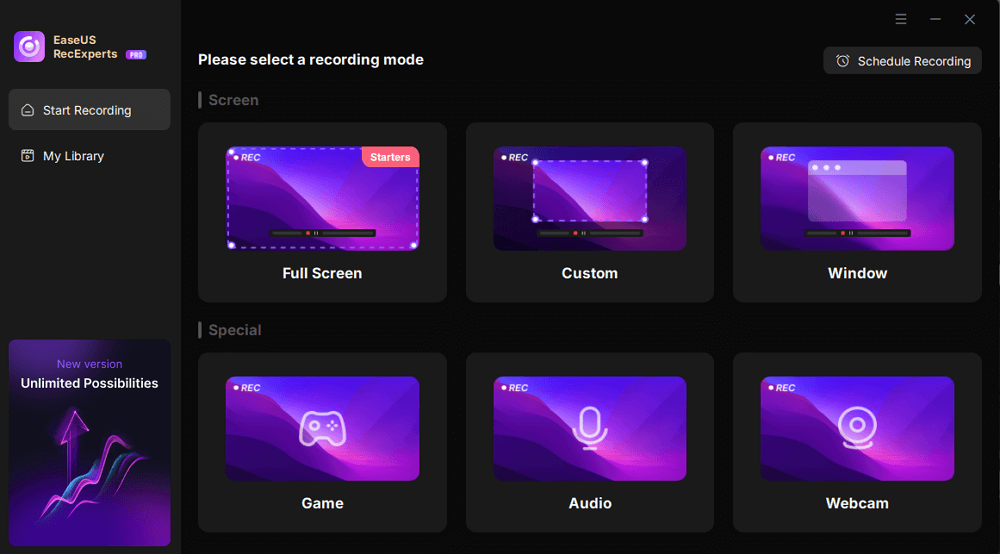
EaseUS RecExperts is primarily a screen recording application rather than a dedicated interval-based timelapse recorder. It supports full-screen, custom-area, window, game, audio, and webcam recording, along with system audio and microphone capture.
This makes it a useful option when your timelapse needs go beyond simply capturing frames at intervals. For example, you may want to record a coding session with audio, capture a tutorial with your microphone, or keep the original footage to edit later.
Key Features
- Record the full screen, a custom area, or a specific window
- Record system audio and microphone audio
- Record webcam footage alongside the screen
- Schedule recordings to start and stop automatically
- Auto-stop and auto-split options
- Trim recorded footage
- Change video playback speed
- Support high-resolution screen recording, including up to 4K on supported configurations
- Export recordings in multiple video formats
🚩Why Use RecExperts for a Timelapse?
The workflow is straightforward: Record your screen → trim unwanted footage → increase playback speed → export.
RecExperts also supports scheduled recording, so you can set a start time and recording duration for unattended captures. Its recording workflow includes options like auto-stop and auto-split, which can help with longer sessions.
The important limitation is that RecExperts does not natively capture a screen timelapse by taking frames at a chosen interval. Instead, it records normal video. You then turn that recording into a timelapse during editing.
That distinction matters because a dedicated timelapse recorder can avoid creating a full-length source video in the first place.
PROS
✔
Flexible screen, window, audio, and webcam recording
✔
Scheduled recording is useful for long or unattended sessions
✔
Lets you retain the original recording for later editing
✔
More suitable than dedicated timelapse tools when audio is important
✔
Includes basic editing capabilities
CONS
●
Does not create an interval-based timelapse directly
●
A long session produces a full-length source recording
●
You need an additional editing step to create the final timelapse
2. Lapse
Best for: Users who want to record a long screen session directly as a timelapse.
Lapse takes a different approach from conventional screen recorders. Instead of continuously recording normal video, it captures your screen at a selected interval and then stitches those captures into a timelapse.
The current version supports Windows 10/11 and macOS 12 or later. It can capture an entire display or target a specific application window, and its capture interval can be adjusted from 1 to 60 seconds.
Lapse is particularly useful if your main concern is avoiding a large conventional screen-recording file during a long work session.
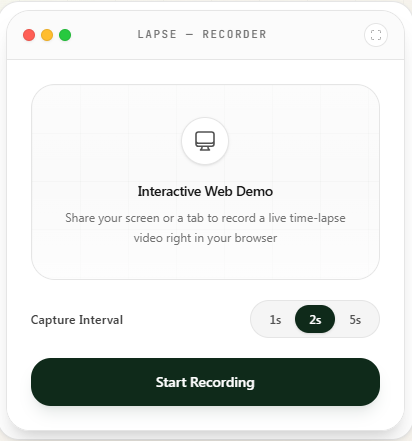
Key Features
- Direct interval-based screen capture
- Capture a full monitor or a specific application window
- Adjustable capture intervals from 1 to 60 seconds
- Local frame stitching
- Adjustable output frame rate
- Resolution scaling
- Multiple export formats, including MP4, WebM, MKV, AVI, MOV, and GIF
- Automatic pause when the system is locked or the targeted window is closed
- Local/offline processing
PROS
✔
Designed specifically for screen timelapses
✔
Interval-based capture
✔
Supports both Windows and macOS
✔
Can target individual application windows
✔
Local processing and multiple export options
CONS
●
Designed around silent timelapse capture
●
Less suitable if you need a normal full-length source recording
●
Fewer conventional screen-recording features than an all-purpose recorder
3. Tau
Best for: Developers, students, designers, and creators who want to document their work process.
Tau is built around the idea of recording work sessions as timelapses rather than using a traditional screen-recording workflow.
Its official guides cover screen, camera, and combined screen-and-camera timelapses. This makes it particularly relevant for workflows such as coding sessions, study sessions, digital design, and other process-based content.
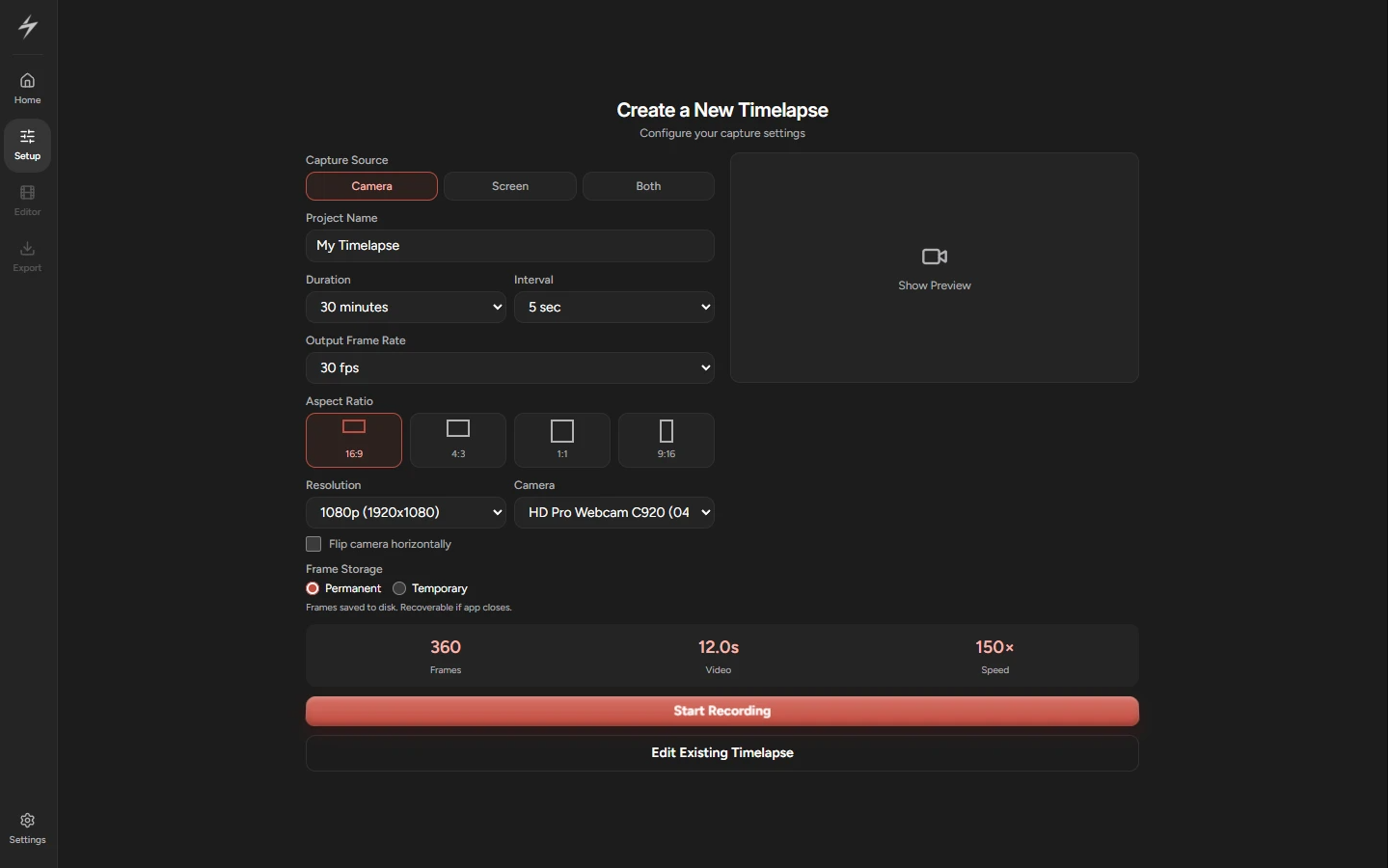
Key Features
- Native screen timelapse recording
- Screen and camera recording workflows
- Ability to combine screen and camera sources
- Adjustable frame intervals
- Timer and clock overlays
- Built-in editing workflow
- Export for sharing
For example, Tau's coding guide recommends using shorter capture intervals when the screen changes frequently and longer intervals for longer sessions. Its study-timelapse guide also shows how the same workflow can be adjusted for sessions where relatively little changes on screen.
PROS
✔
Designed specifically for timelapse workflows
✔
Useful for coding and study sessions
✔
Supports screen-and-camera workflows
✔
Adjustable capture intervals
✔
Built-in editing and export
CONS
●
More specialized than a general-purpose screen recorder
●
May be unnecessary if you only need occasional normal screen recordings
●
Dedicated timelapse workflow is less suitable when preserving continuous audio is the priority
4. ChefLapse
Best for: Users who want a lightweight, automatic screen-timelapse workflow.
ChefLapse is a dedicated desktop timelapse recorder for Windows and macOS. It is designed to turn long sessions into short videos automatically rather than requiring users to record a conventional video and edit it afterward.
The current version supports Windows 10/11 and macOS 12 or later. It can capture an entire screen or a specific application window.
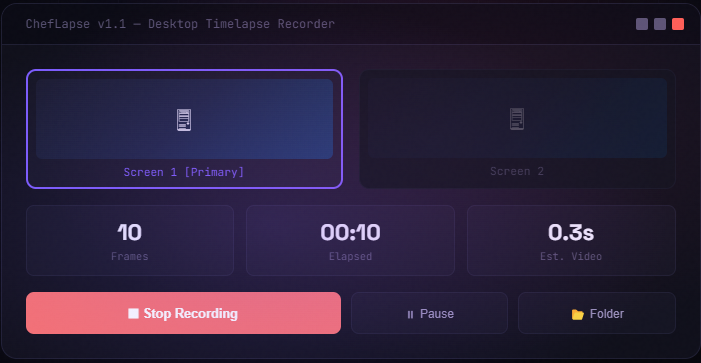
Key Features
- Direct screen timelapse recording
- Window and monitor capture
- Adjustable capture interval
- Adjustable playback speed
- Automatic MP4 export
- Cursor tracking
- Timestamp overlay
- Auto-stop scheduler
- Pause and resume
- Auto-pause when the computer is locked or sleeping
- Automatic cleanup of temporary screenshot frames
- Offline operation
Its window capture is particularly useful for process videos. For example, you can capture a coding editor, drawing application, Blender window, or trading application without recording the rest of your desktop.
PROS
✔
Simple three-step workflow
✔
Designed specifically for desktop timelapses
✔
Automatic MP4 export
✔
Cursor and timestamp options
✔
Auto-stop for long sessions
CONS
●
Focused on timelapse rather than general screen recording
●
Not the right choice if you need a conventional recording with continuous audio
●
Fewer general-purpose recording features than full screen-recording suites
5. Debut Video Capture
Best for: Users who want a traditional screen recorder with a built-in time-lapse mode.
Debut Video Capture is a more established video-capture application that supports screen recording, webcam and other video sources, scheduled recording, and a dedicated Time-lapse option.
Unlike tools that require you to record normal video first, Debut's time-lapse mode lets you specify how frequently a frame should be captured. The software then uses that setting together with the output frame rate to determine the final timelapse duration.
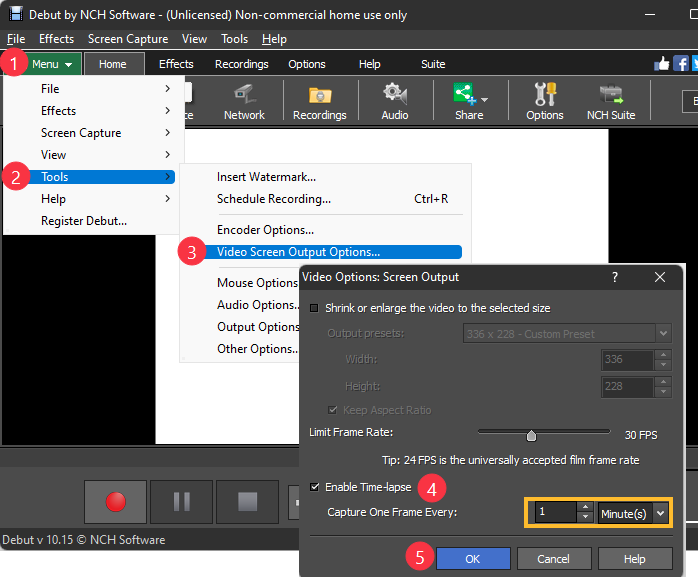
Key Features
- Screen recording
- Full-screen or selected-area capture
- Webcam and other video sources
- Scheduled recording
- Built-in time-lapse recording
- Adjustable capture interval
- Adjustable output frame rate
- Video resizing and output settings
- Multiple output formats
PROS
✔
Native time-lapse recording
✔
Flexible capture interval
✔
Screen, webcam, and other capture sources
✔
Scheduled recording
✔
Available on Windows and macOS
CONS
●
No audio in Time-lapse mode
●
Interface is more traditional than newer dedicated timelapse tools
●
Output length depends on understanding both capture interval and frame-rate settings
6. OBS Studio
Best for: Advanced users who want a free, open-source screen recorder and don't mind creating the timelapse afterward.
OBS Studio is not a dedicated timelapse recorder. It is a free and open-source application for video recording and live streaming, with extensive control over video and audio sources.
It can capture windows, displays, webcams, capture cards, images, browser windows, and other sources. Its audio mixer also provides per-source controls and filters.
OBS works well when you want to preserve a normal recording first and then create the timelapse during post-production. For example:
OBS → normal screen recording → video editor → speed up → final timelapse
This gives you much more control over the original footage than an interval-based recorder, but it also means that you need to store and process the complete recording.
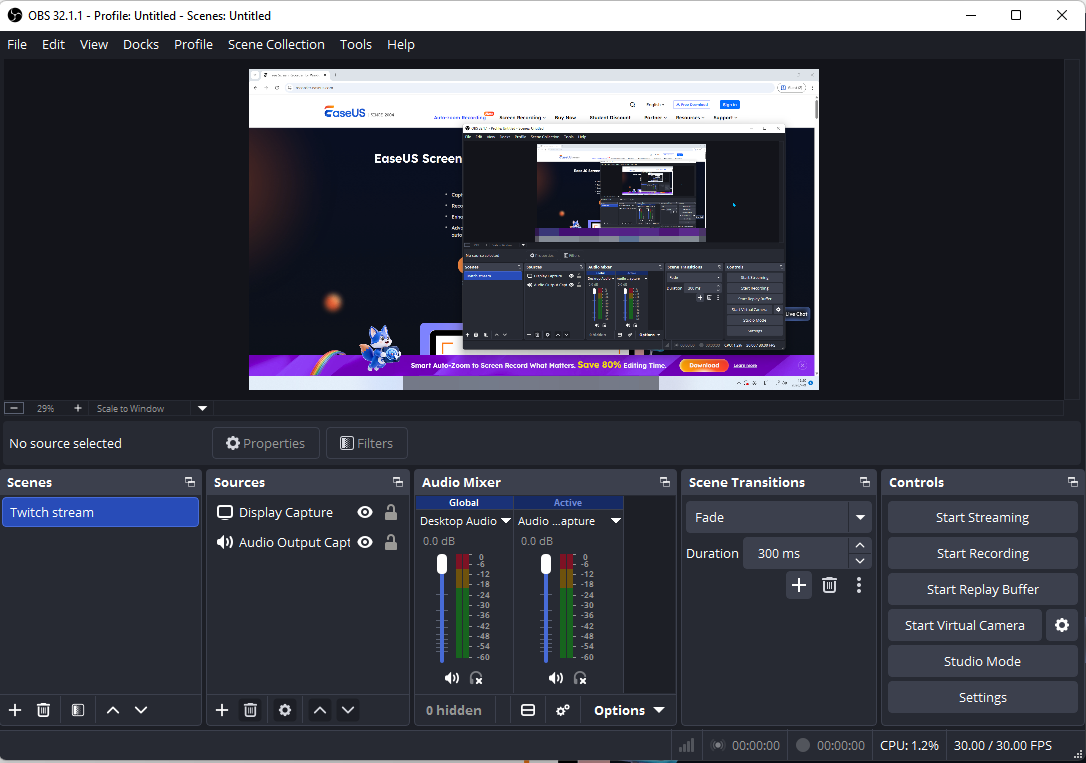
Key Features
- Display and window capture
- Webcam and capture-card support
- Multiple scenes and sources
- Audio mixer and filters
- Highly configurable recording settings
- MKV recording option for safer recovery from interrupted recordings
PROS
✔
Free and open source
✔
Highly configurable
✔
Supports multiple video and audio sources
✔
Works across Windows, macOS, and Linux
✔
Excellent for users who also need streaming or advanced recording
CONS
●
No dedicated timelapse workflow
●
Requires post-production to create a timelapse
●
Long recordings can create large source files
Timelapse Recorder vs. Normal Screen Recorder: Which Should You Use?
The best workflow depends on what you want from the final video.
|
|
Dedicated Timelapse Recorder |
Normal Screen Recorder + Speed Up |
|
How it works |
Captures frames at intervals |
Records normal video |
|
Source file |
Usually avoids a full-length video |
Full-length recording is created |
|
Audio |
Often unavailable |
Usually available |
|
Post-production |
Minimal |
Usually required |
|
Editing flexibility |
Lower |
Higher |
|
Long sessions |
Well suited |
Requires more storage |
|
Original footage |
Usually not retained as a normal video |
Retained |
|
Best for |
Process timelapses |
Tutorials, work logs, flexible editing |
Choose a Dedicated Timelapse Recorder If:
- You only need a short summary of a long process.
- Your session lasts several hours.
- You don't need continuous audio.
- You want to minimize post-production.
- You want the final timelapse immediately after recording.
Record Normally and Speed It Up If:
- You need system audio or microphone narration.
- You may want to reuse the original footage.
- You want to remove specific sections.
- Different parts of the recording need different playback speeds.
- You already use a video editor.
- For many users, the second workflow is more flexible. A dedicated timelapse recorder becomes more useful when the main priority is capturing a long process efficiently without keeping a full-length recording.
Final Verdict
A timelapse screen recorder does not have to be a traditional screen recorder with a speed up button. The tools in this list use two fundamentally different approaches.
Lapse, Tau, ChefLapse, and Debut are more suitable when you want to create a timelapse directly from a long screen session.
EaseUS RecExperts and OBS Studio are better suited to the alternative workflow: record the screen normally, keep the original footage, and create the timelapse afterward.
If you need a general-purpose screen recorder with audio, webcam support, scheduled recording, multiple capture modes, and basic editing, EaseUS RecExperts offers a more flexible workflow. If your only goal is to capture hours of work as a short silent timelapse with minimal post-production, a dedicated timelapse application is likely to be more direct.
The right choice ultimately depends on whether you value efficient timelapse capture or flexible screen recording and editing.
FAQ
1. How to Make a Timelapse From a Screen Recording?
You can turn a normal screen recording into a timelapse by trimming unnecessary footage and increasing its playback speed. For example, a 2-hour recording becomes 12 minutes at 10× speed, 6 minutes at 20×, or 2 minutes at 60×.
If you want to keep the original footage, record normally with a screen recorder such as EaseUS RecExperts or OBS Studio, then speed it up during editing.
2. What Is the Best Timelapse Screen Recorder for Coding?
For coding sessions that last several hours, Tau and ChefLapse are designed for screen timelapses and can capture application-based workflows without creating a full-length recording. If you need microphone or system audio, a conventional screen recorder such as EaseUS RecExperts or OBS Studio offers more flexibility.
3. What Is the Best Timelapse Screen Recorder for Digital Art?
A dedicated timelapse recorder can be convenient for long drawing, animation, or 3D modeling sessions. ChefLapse supports application-window capture for workflows such as Blender and Aseprite. A conventional screen recorder is a better fit if you also need audio or more control over the original footage.
4. Does a Screen Timelapse Record Audio?
Usually not when using native interval-based timelapse capture. These tools capture frames at intervals rather than continuously recording video and audio. For example, Debut's Time-lapse mode does not record audio. If audio is important, record your screen normally and speed up the video afterward.
5. Is It Better to Record a Timelapse Directly or Speed Up a Screen Recording?
It depends on your needs. Direct timelapse recording is useful for long processes when you only need a short final video. Normal recording + speed-up is more flexible if you want to keep the original footage, record audio, or make detailed edits later.
6. How Long Should a Screen Timelapse Be?
There is no fixed length. A short 30–60-second timelapse can work well for a quick process demonstration, while tutorials and portfolio videos may need more time. For normal recordings, use Final duration = Original duration ÷ Playback speed to estimate the result.